
Public Commissions
Corvus Curiositas (2019)
Public Commission from the Prince George Public Library
Description
This installation is made to be interactive. The cross bar on the lamppost, the one the ravens are sitting on rotates 360+ degrees as the viewer turns the large steering wheel. As the ravens are made from a variety of metals that decompose with time, where ever the ravens are left by the viewer, the rain and weather with deteriorate the ravens over time, leeching the rust and oxidization colours on the top surface of the concrete base. Imprinted on that concrete base is Aesop's fable of the Raven and the Pitcher. Over time the writing on the concrete will soak up the rust and oxidization, and create a sort of mandala effect.
Statement
This installation investigates the raven as a world-wide cultural symbol. Although ravens often serve as symbols of the North, there are species on every continent, with the exception of Antarctica. Arguably one of the most prolific symbols, ravens are featured in countless cultures and sub-cultures: sometimes ominous, sometimes friend and sometimes something that purposefully straddles good and evil.
My artistic practice examines, physically and conceptually, the accumulation of small objects. By amassing these objects into new forms my work entices the viewer to re-evaluate what they interact with on a daily basis. The objects that form each raven - components of typewriters, timepieces and printing machines - are tools that assist with expression, creativity, research, and the sharing of knowledge. This also describes attributes of the library. But, these objects allude to an additional purpose. They are small and shiny - they are objects that could be easily collected by a raven. While scientist are still puzzled by the penchant of ravens and trinkets, the likely theory is that they are simply curious. Curiosity is an important tool in learning to shape our future and given the referenced passage from Aesop’s fable, we are in charge of creating our own destiny.
The image of a raven on a lamp post is perhaps as iconic as the raven itself. This image is referenced in visual art, film and literature and, in popular culture, wherein the subject is often depicted as mysterious, reflective, or scheming. Delving deeper into the historical social-cultural role of the raven, they seem to have played a much more affirmative role as protectors, messengers, and gods. Viewers may have strong, varying associations with the raven whether they are familiar with Indigenous people’s origin stories or are fans of the poet, Edgar Allen Poe.
The raven serves as a poignant metaphor for the multicultural community to which we live. The iconography allows viewers to come together to interpret the sculpture in many ways and to draw associations from multiple backgrounds. Storytelling and the circulation of ideas promotes understanding and contributes to tolerance and acceptance of other cultures, their symbology, belief systems, and practices.
Inclusivity and interaction are also important aspects of the work. While the metal components that comprise the ravens’ could be sealed to remain in a similar state for years to come, their degradation is central to the concept of the sculptures. The natural patinas that form as metal ages document the passing of time and the effect of the environment. The positioning of the ravens after interaction with a viewer will directly affect the placement of the patina on the concrete base. As a process that develops slowly, individuals may not be aware of their participation to the changes occurring on the base, however they are contributing nevertheless. As the colouration becomes more apparent, viewers may respond purposefully to the sculpture, affecting the base. The relative unpredictability of the piece in years to come is a fascinating part of my interest as an artist interacting with the public through art.
 |  |  |
|---|---|---|
 |  |  |
 |  |  |
Obelisk (2007)
Public Commission from Concordia University (Montreal)
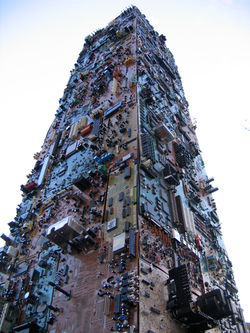
An obelisk is a tall four sided tapered monolithic form which ends in a pyramidal top and is adorned with inscriptions or hieroglyphs. Often placed in the centre of large open spaces, or paired and placed on either side of a path or entrance. Its form is among the earliest public monuments dating to 230 AD. Many cultures have adopted the form over the centuries, modifying its significance to suit their belief. For Ancient Egyptians, it represented the stability and the creative force embodied by the solar god RA; for the Roman Empire it was a trophy of affluence, an timepiece afforded by only the most fortunate nobility; and for the Americans, many centuries later, it was appropriated for reverence to the death of the first president, standing taller than any other constructed before it, an affirmation of its magnitude and beauty to be an object of pride to the American people.
This sculpture takes shape as a ten foot tall techno-obelisk. It necessitates neither a respect of the gods, nor an elaborate timepiece, nor a monument of unification, but instead serves as an admonition of a prodigal age. With its surplus of discarded and forgotten technological detritus, the material which is offered a new life to exist as a meaningful object that demands consideration and expresses consequence, not only within its own state of existence but the state of our existence in relation to those materials. As the sun shimmers, the substrate refracts and reflects twists and bends the light onto the ground, the wall, the world. Standing upon a black base formed in the likeness of Trafalgar Square’s renowned art plinths, the monument also suggests a correlation between our current zeitgeist and how visual culture is also something consumed heavily.
 |  |  |
|---|---|---|
 |  |  |
 |  |  |
 |  |  |
 |